
Kano Charts a New Path for Health Security: Turning the Public Health Security Law 2025 into Action
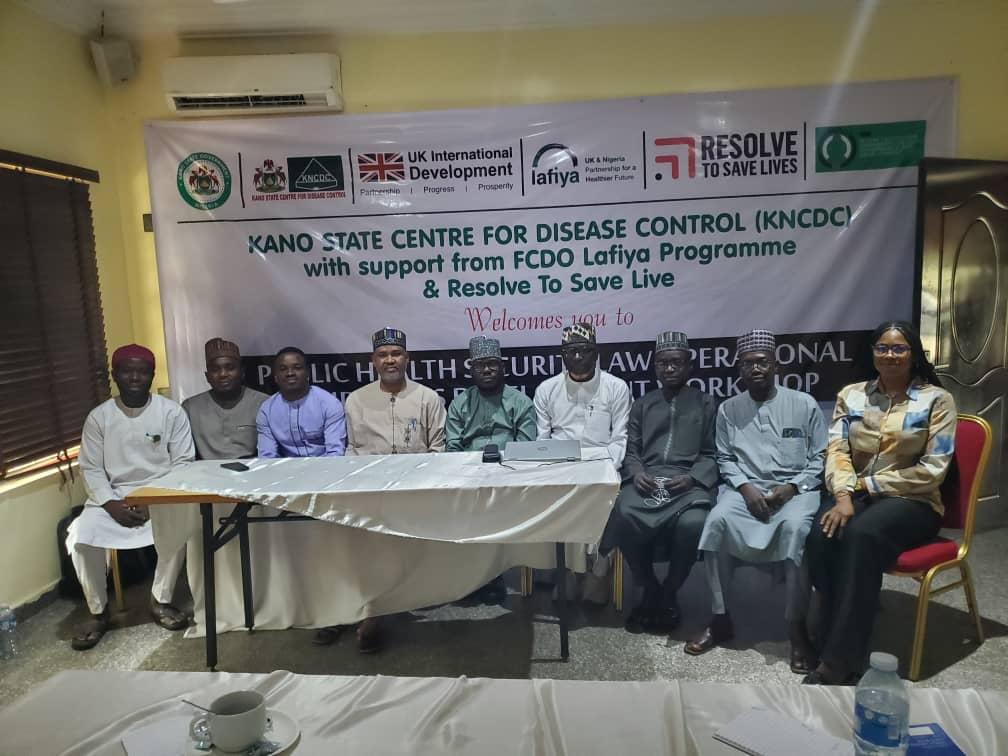
The Kano State Government, through the Kano State Centre for Disease Control (KNCDC), convened a three-day multi-stakeholder technical meeting to review and refine the Draft Operational Guidelines for the Implementation of the Kano State Public Health Security Law 2025. The meeting, held in Kano, brought together senior government officials, technical experts, and development partners in a collaborative effort to ensure that the operational framework underpinning the Public Health Security Law is functional, pragmatic, and fully aligned with national and international standards, including the International Health Regulations (IHR 2005).
Participants included representatives from key Ministries, Departments, and Agencies (MDAs) of the State, notably the Ministry of Health, Ministry of Agriculture and Natural Resources, Ministry of Environment, Primary Healthcare Management Board, and the Medical Laboratory Science Council of Nigeria (MLSCN). Development and technical partners present were Resolve to Save Lives (RTSL), Orixine Consulting, Lafiya Palladium, and CAGDIEV, among others. The diverse representation reflected a shared recognition that public health security is an intersectoral responsibility that depends on strong coordination mechanisms and clearly defined institutional mandates.
The three-day technical meeting provided a structured platform for in-depth deliberation on each section of the draft operational guidelines. The discussions focused on strengthening institutional coordination, amplifying surveillance and reporting procedures, defining inter-agency communication protocols, and ensuring that operational structures reflect both the letter and spirit of the Law. Participants worked meticulously to translate the legal provisions of the Kano State’s Public Health Security Law of 2025 into actionable and measurable steps for effective and easy implementation by the various responsible entities.
Key outputs of the deliberations included:
- Clarification of institutional roles and mandates: The operational guidelines now clearly delineate the responsibilities of the Public Health Laboratory System, giving it a defined role in surveillance, outbreak investigation, and emergency response.
- Operationalization of the Public Health Security Fund: The document establishes transparent procedures for the utilization of the Fund, ensuring accountability, fiscal discipline, and compliance with public finance management principles.
- Capacity development provisions: The guidelines introduce structured training schedules for surveillance officers and other public health personnel, focusing on preparedness, rapid response, and event-based surveillance.
- Coordination and reporting framework: The revised draft integrates a formal reporting and communication pathway between the KNCDC, relevant MDAs, and the national health security coordination platforms, ensuring seamless information flow during public health events.
In his opening remarks, Professor Muhammed A. Abbas, Director General of the KNCDC, commended the collaborative nature of the exercise, noting that “these guidelines are not merely technical tools but governance instruments that strengthen preparedness and safeguard the health security of the people of Kano State.” He emphasized the State’s determination to institutionalize health security governance by ensuring that all implementing agencies understand their mandates, work collaboratively, and operate within a coherent framework.
Barrister Aniekan Akpan, representing Orixine Consulting, delivered a presentation on the functional importance of operational guidelines in the implementation of statutory frameworks. He highlighted that while laws provide the legal foundation, operational guidelines are the “living instruments” that give life to legal provisions by translating them into practical actions, standard operating procedures, and measurable outcomes. He further observed that well-designed guidelines are indispensable for ensuring institutional accountability, inter-agency coherence, and the sustained effectiveness of public health actions.
The participatory review process also underscored the necessity of embedding flexibility and adaptability within the operational guidelines. This ensures that the framework remains responsive to evolving health threats, new scientific evidence, and changing governance realities. Participants agreed that periodic review of the guidelines will be essential to maintain alignment with emerging national priorities and global health security standards.
By the end of the three days, the draft operational guidelines had undergone significant technical refinement to enhance their clarity, practicality, and implementability. The outcome document now provides a clear roadmap for translating legislative intent into coordinated operational action, reinforcing transparency in decision-making, and promoting sustainable health security governance in Kano State.
The KNCDC expressed its commitment to facilitating the next phase of the process — validation, approval, and dissemination of the final guidelines — which will enable MDAs and implementing institutions to commence full-scale operationalization. The final document will also serve as a reference tool for future epidemic preparedness planning, response coordination, and institutional capacity development within the state.
Orixine Consulting, in collaboration with Resolve to Save Lives and other partners, reaffirmed its continued technical support to the Government of Kano State in strengthening health security systems and governance mechanisms. This milestone reflects the broader national effort to institutionalize health security reforms at the subnational level, ensuring that states are adequately equipped to prevent, detect, and respond effectively to public health emergencies in line with the IHR (2005) and Nigeria’s National Action Plan for Health Security (NAPHS).